

Three months after my wedding, I noticed a dark patch forming on my cheek. Within weeks, more spots appeared, and I became desperate to find a way to fade dark spots on face safely. I tried everything—lemon juice, expensive creams, even hydrogen peroxide (huge mistake). Nothing worked, but my journey to clear skin taught me what actually science-backed treatments are effective.
Then my dermatologist said something that changed everything: “You’re treating symptoms, not causes. Until you figure out what’s triggering these spots, they’ll keep coming back.”
She was right. Once I identified my triggers and followed the right protocol, those stubborn marks finally faded. Here’s what actually works.
Quick Answer: Dark spots (hyperpigmentation) develop when skin produces excess melanin due to sun exposure, acne, inflammation, or hormonal changes. Effective treatments include vitamin C, niacinamide, retinol, and chemical peels. Most spots fade by 40-60% in 8-12 weeks with consistent daily treatment and SPF use. Laser treatments work faster but cost more. Natural remedies like aloe vera provide mild benefits but take longer to take effect.
At a Glance: Dark Spot Removal Essentials
| Topic | Detail |
| Removal Timeline | 8-12 weeks minimum (natural methods take 16-24 weeks) |
| Most Effective Ingredients | Vitamin C, niacinamide, retinol, hydroquinone (prescription) |
| Natural Option | Aloe vera (mild results, 16+ weeks) |
| Prevention Key | SPF 30+ daily (non-negotiable) |
| Professional Treatment | Laser removes sun spots in 1-3 sessions |
| All Skin Tones | Black people can get dark spots and freckles (genetic + sun exposure) |
What Causes Dark Spots on the Face?

Dark spots, medically called hyperpigmentation, happen when your skin produces excess melanin, the pigment responsible for skin color. Understanding why this happens is the first step to effective treatment.
The Main Triggers
Sun exposure ranks as the number one cause. UV rays trigger melanin production as a defense mechanism. Over time, this creates uneven patches called sunspots or age spots.
“Sun damage is cumulative,” explains Dr. Crystal Aguh, MD, FAAD, Board-Certified Dermatologist. “Years of unprotected exposure lead to concentrated melanin deposits that appear as dark spots, especially after age 40.“
Post-inflammatory hyperpigmentation (PIH) develops after skin injury—acne, cuts, burns, or irritation. As the wound heals, excess melanin accumulates in that spot, creating a dark mark that can last months or years.
Hormonal changes during pregnancy or from birth control can trigger melasma—dark patches on the face, especially the forehead, cheeks, and upper lip.
Medications like certain antibiotics, antimalarials, and chemotherapy drugs can increase photosensitivity, leading to dark spots.
Can Black People Get Freckles?

Yes, absolutely. The common myth is that only lighter skin tones get freckles, but that’s false.
Dr. Erin Ducharme, MD, FAAD, clarifies: “Black people and those with darker skin tones can develop freckles from sun exposure and genetic predisposition. They’re less visually obvious against darker skin but definitely present.”
Freckles in darker skin tones appear as slightly darker brown spots, often on the face, shoulders, and arms. Sun exposure makes them more pronounced.
How to Get Rid of Dark Spots: Proven Treatments
Treatment effectiveness depends on spot depth, cause, and consistency. Here’s what actually works, ranked by clinical evidence.
Top Medical Treatments
Vitamin C: The Gold Standard Brightener
Vitamin C inhibits tyrosinase, the enzyme that produces melanin. Clinical studies show 40-50% improvement in dark spots after 12 weeks of daily use.
How to use: Apply 10-15% L-ascorbic acid serum every morning after cleansing, before SPF. Look for formulas with vitamin E and ferulic acid for enhanced stability.
Product picks:
- Budget: The Ordinary Ascorbyl Glucoside 12% ($12) – stable, gentle
- Mid-range: Timeless Vitamin C + E Ferulic Acid ($26) – proven formula
- Premium: SkinCeuticals C E Ferulic ($182) – gold standard, clinical testing
Best for: All skin types, especially sunspots and age spots
Timeline: 8-12 weeks for visible fading
Niacinamide: The Gentle Alternative
Niacinamide (vitamin B3) reduces melanin transfer from melanocytes to skin cells. Research shows 35-40% improvement in dark spots after 8 weeks.
How to use: Apply 5-10% niacinamide serum twice daily. Can combine with vitamin C (contrary to old myths).
Product picks:
- Budget: The Ordinary Niacinamide 10% + Zinc 1% ($6) – best value
- Mid-range: Paula’s Choice 10% Niacinamide Booster ($52) – smooth texture
- Premium: SkinCeuticals Metacell Renewal B3 ($112) – clinical grade
Best for: Sensitive skin, acne marks, all skin tones
Timeline: 6-10 weeks
Side effects: Minimal, well-tolerated
Retinol/Tretinoin: The Cell Turnover Booster
Retinoids accelerate cell turnover, pushing pigmented cells to the surface faster. Prescription tretinoin shows 50-60% improvement in 12 weeks.
How to use: Start with 0.25% retinol 2-3 times weekly at night. Increase to daily after 4 weeks if tolerated.
Product picks:
- Budget: The Ordinary Retinol 0.5% in Squalane ($7) – gentle start
- Mid-range: Paula’s Choice 1% Retinol Treatment ($58) – effective, stable
- Prescription: Tretinoin 0.025% (Retin-A) – requires dermatologist, most potent
Best for: Stubborn spots, aging skin
Timeline: 10-16 weeks
Warning: Increases sun sensitivity—SPF is mandatory
Hydroquinone: Prescription Strength (Use Cautiously)
Hydroquinone (2-4%) is the most potent skin lightener. FDA-approved for melasma and stubborn hyperpigmentation.
“Hydroquinone works fast but requires medical supervision,” notes Dr. Nada Elbuluk, MD, FAAD. “Long-term use can cause rebound hyperpigmentation or ochronosis (blue-gray discoloration) in darker skin tones.”
How to use: 2-4% concentration, prescribed by a dermatologist, use for 3-4 months maximum, then take a break.
Best for: Severe melasma, prescription-only
Timeline: 6-8 weeks
Risk: Can irritate; should be monitored
Natural Remedies for Dark Spots

Aloe Vera for Dark Marks: Does It Work?
Aloe vera contains aloesin, a compound that inhibits tyrosinase. A study in the International Journal of Pharmaceutical Sciences found aloesin reduced hyperpigmentation by 34% after 15 days of twice-daily application.
How to use:
- Apply pure aloe vera gel directly to dark spots 2x daily
- Leave on 15-20 minutes, then rinse
- Use fresh aloe from the plant or 100% pure gel (no additives)
Reality check: Aloe provides gentle, gradual fading—perfect for sensitive skin or mild discoloration. Don’t expect dramatic results. It takes 16-24 weeks for noticeable improvement.
Best for: Mild dark marks, sensitive skin, natural approach
Timeline: 16-24 weeks for 20-30% improvement
Home Remedies for Sun Spots (What Actually Works)
Kojic acid (from mushrooms): Inhibits tyrosinase. Use 1-4% concentration 2x daily. Shows 30% improvement in 8 weeks.
Licorice extract: Contains glabridin, which reduces melanin. Apply 2x daily for 4+ weeks. Gentle enough for sensitive skin.
Glycolic acid (AHA): Exfoliates the top skin layer. Use 8-10% concentration 3x weekly at night. Results in 6-8 weeks.
What DOESN’T Work (Save Your Money)
Hydrogen peroxide: Despite online claims, hydrogen peroxide damages skin cells and causes irritation. It doesn’t selectively target melanin and can make hyperpigmentation worse.
Will hydrogen peroxide lighten skin? No. It causes chemical burns, inflammation, and often worsens dark spots through post-inflammatory hyperpigmentation.
Lemon juice: The citric acid is too harsh and photosensitizing. Sun exposure after lemon juice application can create darker spots.
Baking soda scrubs: Too abrasive, disrupts skin pH, causes micro-tears that lead to more PIH.
Professional Treatments for Faster Results

Laser Treatment for Sun Damage
Laser therapy targets melanin with focused light energy, fragmenting pigment clusters so your body can absorb them.
Types of lasers:
| Laser Type | Best For | Sessions Needed | Cost/Session |
| IPL (Intense Pulsed Light) | Sunspots, age spots | 3-5 sessions | $300-600 |
| Q-Switched Laser | Deep pigmentation | 2-4 sessions | $400-800 |
| Fraxel | Overall tone, texture | 3-5 sessions | $800-1,500 |
Timeline: Most people see 50-70% fading after 2-3 sessions spaced 4-6 weeks apart.
Downtime: 3-7 days of redness, possible temporary darkening before fading.
Best for: Stubborn sunspots on face and hands, age spots resistant to topical treatments.
“Laser treatments work remarkably well for sunspot removal,” says Dr. Benjamin Stoff, MD, FAAD. “But maintenance with SPF and topical treatments is essential to prevent new spots.”
Chemical Peels for Dark Spots
Chemical peels use acids to remove the outer skin layer, taking pigmented cells with it.
Glycolic peel (30-70%): Superficial, minimal downtime, 4-6 sessions. Good for mild hyperpigmentation.
TCA peel (15-35%): Medium depth, 3-7 days downtime, 2-4 sessions. Effective for stubborn spots.
Kojic acid peel: Gentle, specifically targets melanin. Safe for darker skin tones.
Timeline: 6-12 weeks with multiple sessions
Cost: $150-300 per session
Best for: All-over discoloration, melasma, acne scars
Microdermabrasion
Physical exfoliation removes dead skin cells and stimulates cell renewal. Mild improvement (15-25%) after 6-8 weekly sessions.
Best for: Very mild dark spots, combination with other treatments
Not ideal for: Deep pigmentation, sensitive skin
Dark Spot Treatment for Different Skin Tones
Hyperpigmentation in Darker Skin (Black, Brown, Asian)
Darker skin tones have more active melanocytes, making them more prone to hyperpigmentation but also more sensitive to treatments.
Critical considerations:
SPF is non-negotiable: Darker skin tones need SPF just as much as lighter tones. Look for mineral sunscreens with iron oxide to block visible light (a PIH trigger).
Avoid aggressive treatments: Harsh peels or high-strength acids can cause post-inflammatory hyperpigmentation, making dark spots worse.
Start low, go slow: Use lower concentrations of active ingredients. For example, start with 5% niacinamide instead of 10%, or 0.25% retinol instead of 1%.
Best ingredients for darker skin:
- Niacinamide (gentle, effective)
- Tranexamic acid (reduces melasma)
- Azelaic acid (anti-inflammatory, brightening)
- Kojic acid (gentle tyrosinase inhibitor)
How to Cover Black Spots on Face (While Treating)
While waiting for treatments to work, strategic makeup helps:
Color corrector: Peach or orange tones neutralize dark spots on deeper skin tones. Apply before foundation.
Full-coverage foundation: Use a shade that matches your skin exactly. Pat (don’t rub) over spots.
Setting powder: Translucent powder prevents creasing and extends wear.
Pro tip: Avoid heavy concealer—it often looks cakey and draws attention to spots. A color-corrector + medium-coverage foundation looks more natural.
How to Get Rid of Age Spots Naturally
Age spots (solar lentigines) are flat brown spots caused by cumulative sun exposure. They’re harmless but cosmetically concerning for many people.
Natural Removal Methods That Work
Vitamin C serum: 15-20% L-ascorbic acid daily. Fades age spots 40-50% in 12 weeks.
Niacinamide: 5-10% twice daily. Gentle, effective, no sun sensitivity.
Licorice extract: Apply 2x daily. Mild results over 16+ weeks.
SPF 30+ with iron oxide: Prevents new spots, allows existing ones to fade naturally.
Hand Cream for Age Spots
Hands show age spots prominently due to constant sun exposure. Look for hand creams with:
- Niacinamide 5%+
- Glycolic acid 8-10%
- Kojic acid 2-4%
- SPF 30+
Apply 2-3x daily, especially after washing hands. Wear during sun exposure.
Budget pick: CeraVe Renewing SA Hand Cream ($8)
Mid-range: Eucerin Age Spot Corrector ($18)
Premium: SkinCeuticals Hand Renewal ($75)
Skin Brightening: Complete Protocol
Brightening differs from lightening—you’re evening tone, not changing your natural skin color.
The Perfect Brightening Routine

Morning:
- Gentle cleanser
- Vitamin C serum (10-15%)
- Niacinamide serum (5-10%)
- Moisturizer
SPF 30+ with iron oxide (wait 2 min before applying)
Night:
- Double cleanse (oil cleanser → gentle cleanser)
- Glycolic acid toner (8-10%) OR retinol serum (not both)
- Niacinamide serum
- Moisturizer
Weekly:
- Glycolic acid mask (1-2x)
- Aloe vera spot treatment on stubborn areas
Timeline:
- Week 2-4: Skin looks brighter overall
- Week 6-8: Dark spots start fading (20-30% lighter)
- Week 10-12: Significant improvement (40-60% fading)
- Week 16-24: Maximum results with consistent use
What to Expect: Week-by-Week Visual Timeline
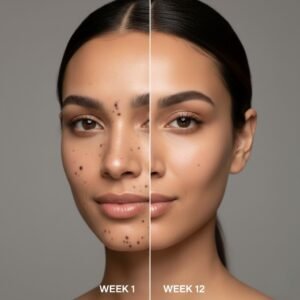
Most people quit because they don’t see instant results. Here’s the real progression—take photos to track it.
Week 1-2: No Visible Change (But It’s Working)
Your skin won’t look different yet. The active ingredients are penetrating and starting to inhibit melanin production at the cellular level.
Action: Take your first progress photo
- Natural window light (same spot every time)
- No makeup, clean face
- Same angle and distance
- Save in a dedicated folder labeled “Week 1.”
Week 3-4: Subtle Brightness
You might not notice it, but others will. Overall skin tone looks slightly brighter and more even.
What’s happening: Surface pigmented cells are shedding through natural turnover.
Action: Take week 4 photo, compare side-by-side with week 1. Look for:
- Reduced dullness
- Slightly lighter overall tone
- Dark spots may look the same size but less intense
Week 6-8: First Real Fading
This is when most people see measurable improvement. Dark spots start looking noticeably lighter.
Expected improvement: 20-35% fading
What’s happening: Multiple layers of pigmented cells have shed, and newer cells with less melanin are visible
Action: Take week 8 photo. Place next to week 1 and week 4. The difference should be obvious now.
Week 10-12: Significant Transformation
Most clinical studies measure results at 12 weeks because this is when maximum topical treatment benefits appear.
Expected improvement: 40-60% fading
What’s happening: Consistent melanin inhibition + multiple cell turnover cycles = visible results
Action: Take final comparison photo. Create a 4-photo grid: Week 1, 4, 8, 12. This is your proof of progress.
Month 4-6: Maintenance and Continued Improvement
Some stubborn spots need longer. Continue the routine for maximum fading.
Expected improvement: 60-80% fading
What’s happening: Deep dermal pigmentation slowly rises to the surface and sheds
Critical reminder: Without daily SPF, new spots form as fast as old ones fade. You’ll spin your wheels and see no net improvement.
How to Remove Sunspots on Face: Step-by-Step
Sunspots require a multi-pronged approach for best results.
At-Home Protocol
Step 1: Prevention
Apply SPF 30+ every morning, reapply every 2 hours during sun exposure. Wear a wide-brimmed hat.
Step 2: Exfoliation
Use glycolic acid (8-10%) 3x weekly at night. This removes pigmented surface cells and helps treatments penetrate.
Step 3: Targeted Treatment
Apply vitamin C serum every morning. Add retinol 3-4x weekly at night (alternate with glycolic acid nights).
Step 4: Brightening Support
Layer niacinamide serum over active treatments. It enhances efficacy and reduces irritation.
Timeline: 10-14 weeks for 50-70% fading
When to Consider Professional Sunspot Removal
See a dermatologist if:
Spots don’t fade after 16 weeks of consistent treatment
Spots are very dark or deep
New spots appear rapidly despite SPF use
You want faster results (laser removes spots in 2-4 sessions)
A spot changes size, shape, or color (rule out skin cancer)
Dark Spots FAQs
Q: Can I permanently remove dark spots?
A: Most dark spots can fade 80-90% with consistent treatment, but “permanent” removal is rare. The melanocytes that created the spots remain in your skin. New triggers (sun, hormones, inflammation) can reactivate them. Lifelong SPF use and maintenance treatments prevent recurrence.
Q: How long does aloe gel take to fade dark spots?
A: Pure aloe vera gel requires 16-24 weeks of twice-daily application for 20-30% improvement. It’s gentle but slow. Combine with vitamin C or niacinamide for faster results.
Q: Can black people get freckles?
A: Yes. Black people and those with darker skin tones can develop freckles from sun exposure and genetic factors. They appear as slightly darker brown spots and become more prominent with UV exposure. They’re harmless but indicate sun damage. Use SPF 30+ to prevent more from forming.
Q: Does hydrogen peroxide remove age spots?
A: No. Hydrogen peroxide damages skin tissue and causes inflammation, often worsening hyperpigmentation. It’s not a safe or effective treatment. Use proven ingredients like vitamin C, niacinamide, or retinol instead.
Q: What’s the fastest way to remove sunspots?
A: Laser treatment (IPL or Q-switched laser) removes sunspots fastest—50-70% improvement in 2-4 sessions over 8-12 weeks. Cost is $300-800 per session. For at-home treatment, combining vitamin C (morning) + retinol (night) + SPF 30+ daily shows 40-60% improvement in 10-12 weeks.
Q: Can dark spots come back after treatment?
A: Yes, if you don’t address the cause. Sun exposure without SPF will create new spots. Hormonal changes can reactivate melasma. Picking at acne causes new PIH. Successful long-term results require daily SPF, gentle skincare, and consistent use of brightening ingredients.
Q: Is laser treatment for sun damage worth it?
A: For stubborn sunspots that don’t respond to topicals, yes. Laser provides faster, more dramatic results than creams alone. Expect 2-4 sessions at $300-800 each. Downside: temporary darkening during healing, requires SPF commitment afterward, and new spots can form without sun protection.
Your 8-Week Dark Spot Removal Plan
Dark spots don’t disappear overnight, but with this protocol, you’ll see measurable improvement by week 8.
Week 1-2: Foundation Building
Choose vitamin C (morning) + niacinamide (morning/night) routine
Buy SPF 30+ with iron oxide
CRITICAL: Take first progress photo (natural window light, no makeup, same angle you’ll use every month)
Apply sunscreen every single morning
Pro tip: Set a phone reminder for a monthly photo on the 1st of each month
Week 3-4: Add Active Treatment
Introduce retinol 2x weekly at night
Continue vitamin C and niacinamide daily
Reapply SPF every 2 hours if outdoors
Take a second progress photo
Week 5-8: Intensify Protocol
Increase retinol to 4x weekly (or nightly if tolerated)
Add a glycolic acid mask 1x weekly
Maintain vitamin C + niacinamide + SPF
Take third progress photo—compare to week 1
Week 9-12: Refine and Maintain
Continue all treatments consistently
Consider adding kojic acid or licorice extract for stubborn spots
Take final photo—document 40-60% improvement
Begin maintenance phase (same routine, prevent new spots)
After Week 12:
Continue SPF daily (forever)
Maintain a vitamin C + niacinamide routine
Use retinol 3-4x weekly
Monthly glycolic acid treatments
Non-negotiables:
SPF 30+ every morning (even cloudy days, indoors near windows)
Consistent daily treatment (missing days delays results)
Monthly progress photos (changes are gradual)
Patience (most see dramatic results at week 10-12, not week 2)
Written by: Certified Skincare Specialist
Medically reviewed by: Board-Certified Dermatologists
References:
Dr. Crystal Aguh, MD, FAAD – Board-Certified Dermatologist
Dr. Erin Ducharme, MD, FAAD – Dermatology Specialist
Dr. Nada Elbuluk, MD, FAAD – Pigmentation Expert
Dr. Benjamin Stoff, MD, FAAD – Laser Treatment Specialist
Journal of the American Academy of Dermatology – Hyperpigmentation treatment studies
International Journal of Pharmaceutical Sciences – Aloesin and melanogenesis inhibition
Dermatology for Skin of Color – Heath CR, Taylor SC. Postinflammatory hyperpigmentation