

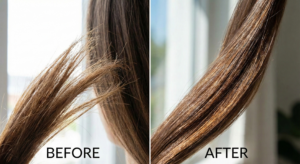
Let’s be honest: we have all been there. You look in the mirror after a bleaching session gone wrong, or maybe you went a little too hard with the flat iron, and suddenly your hair feels like straw. The panic sets in, and you frantically start Googling how to Fix Damaged Hair Without Cutting It.
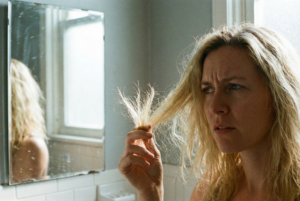
It’s a terrible feeling, but take a deep breath. While you can’t magically glue a dead hair strand back together perfectly, you don’t always have to go for the “big chop” either.
In this guide, we are going to walk through how to fix really damaged hair with methods that actually work—no miracles, just science and good habits. Let’s get your hair’s bounce and shine back.
1. Identifying Hair Damage & Recognizing Distress Signals
Before we can fix the mess, we need to understand exactly what’s going on. Think of these signs as your hair’s “check engine” light.
To begin, examine your strands closely. Do they look dull and matte instead of shiny? That’s usually step one.
- Split Ends (Frayed Tips): If the end of your hair looks like a tree branch forking out, the cuticle is compromised.
- The “Fried” Feeling: If you run your fingers through your hair and it feels rough, crunchy, or like straw, that is severe texture damage.
- The Stretch Test:
- Healthy hair stretches a little and bounces back.
- Damaged hair stretches and snaps (breakage) or feels mushy like gum (chemical damage).
Usually, the culprit is something we love a little too much.
- Thermal Damage: That daily relationship with your curling wand causes “burnt hair,” clinically referred to as Trichorrhexis Nodosa (weak points in the hair shaft).
- Chemical Overload: Excessive use of bleach or relaxer disrupts the internal disulfide bonds.
2. Mastering Your Wash Routine & Cleansing Habits
If you are trying to figure out how to fix damaged hair, the answer often starts in the shower. It sounds simple, but the way you wash your hair might be making things worse.
Believe it or not, your shampoo could be the enemy. Many drugstore shampoos are packed with harsh sulfates (like SLS) that strip away the natural oils your dry hair is desperate for. So, the first swap you need to make is to a sulfate-free, reparative shampoo. Look for bottles that scream “moisture,” “repair,” or “gentle.”
Also, try to resist the urge to wash every day. I know, dirty hair feels gross, but over-washing is dehydrating. Instead, aim for 2–3 times a week. This gives your scalp’s natural oils (sebum) a chance to travel down the hair shaft and act as a free, natural moisturizer.
3. Deep Conditioning & Intensive Repair Rituals
You’re probably wondering how to repair split ends without cutting. Here is the truth: you can’t permanently “heal” a split end, but you can seal it shut temporarily to keep your hair looking smooth.
For a quick fix, you can raid your kitchen.

- Avocado & Honey: Mash a ripe avocado with some honey. The fats in the avocado mimic your hair’s natural lipids, and honey draws moisture in.
- Coconut Oil & Egg: It sounds like breakfast, but the protein in the egg strengthens weak spots, while the oil adds shine.
However, if you are dealing with severely burnt hair, you might need the heavy hitters from the store. Specifically, look for:
- Bond Builders: Brands like Olaplex or K18 are game-changers because they actually repair the broken disulfide bonds inside the hair.
- Keratin Masks: Since hair is made of protein, adding it back in fills the gaps in the cuticle.
4. The Magic of Hair Oils, Elixirs, and Serums
Think of conditioner as a glass of water for your hair, and oil as the lid that keeps the water from evaporating. You need both.
Here is the trick: different oils do different things.
- Argan Oil: Liquid gold for frizz. It sits on top and smooths everything down.
- Coconut Oil: One of the rare oils that actually sinks into the hair to prevent protein loss.
- Jojoba Oil: This is great because it’s chemically very similar to the oil your own skin produces, so it doesn’t feel heavy or greasy.
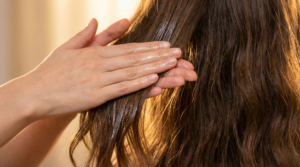
Applying hair serum using praying hands technique on damaged hair
When applying, use the “praying hands” method. Rub a few drops between your palms and clap your hands over your hair, smoothing down from the ears to the ends. This seals the cuticle without making your roots look oily.
5. Breaking Up With Heat & Preventing Thermal Damage
If you are frantically searching for how to fix burnt hair, I have some bad news: you have to break up with your heat tools. At least for a while.
Realistically, heat is what got us into this mess. It cooks the moisture right out of the strand. But, if you absolutely must style your hair for an event, never do it “naked.” A good heat protectant is non-negotiable—it acts as a shield so your hair doesn’t get fried.
Better yet, why not embrace the heatless life?
- Overnight Braids: Sleep in loose braids for beachy waves in the morning.
- Silk Rollers: These are trendy for a reason—they give you blowout volume with zero damage.
6. Minimizing Chemical Exposure & Harsh Processing
When your hair is in the ICU, you need to put it on a “chemical diet.”
For example, try stretching your salon appointments. If you usually get your roots bleached every 4 weeks, try pushing it to 6 or 8. That extra time allows your hair to recover some strength. Similarly, ask your stylist about demi-permanent dyes. They fade faster, but they are much gentler and don’t blast open the hair cuticle like permanent dyes do.
In fact, just reading the back of your product bottles helps. Avoid alcohols (which dry you out) and parabens. The cleaner the product, the happier your hair.
7. Nourishing From Within (Nutrition & Hydration)
We often forget that hair is a part of our body. How to fix really damaged hair isn’t just about what you put on it, but what you put in you.
Fundamentally, your hair is made of keratin, which is a protein. So, if you aren’t eating enough protein (eggs, nuts, lean meats), your body won’t waste energy growing nice hair. Also, don’t forget healthy fats like Omega-3s (salmon, walnuts). They are literally the internal moisturizer for your skin and hair.
And please, drink water. If you are dehydrated, your hair is the first place it shows. It gets limp, dull, and brittle. Two liters a day keeps the breakage away.
8. The “Dusting” Technique & Micro-Trimming Secrets
Okay, you searched for how to fix hair without cutting. But hear me out on the “Dusting” technique.
Essentially, dusting isn’t a haircut. You don’t lose any length. You take a section of hair, twist it tight, and snip off only the tiny hairs that stick out of the twist (the split ends). By doing this, you remove the damage that causes tangles and breakage, but your hair stays the exact same length. It’s a tedious process, but it saves your length while stopping the damage from traveling up the strand.

Medical Perspectives & Clinical References
To understand why these methods work, we need to look at the dermatology behind hair structure.
According to the American Academy of Dermatology (AAD): Dermatologists emphasize that while you cannot “repair” a dead hair strand in the biological sense (since hair is not living tissue), you can improve the integrity of the hair shaft. Dr. Wilma Bergfeld, a dermatologist at the Cleveland Clinic, notes that simple changes, like reducing the frequency of washing and using a conditioner after every shampoo, are clinically proven to increase hair elasticity and reduce breakage.
Furthermore, a study published in the Journal of Cosmetic Science highlights the unique molecular structure of Coconut Oil. Unlike mineral oil or sunflower oil, coconut oil has a high affinity for hair proteins and a low molecular weight, allowing it to penetrate inside the hair shaft and reduce protein loss for both undamaged and damaged hair.
Additionally, medical experts warn about “Bubble Hair.” This is a condition observed by doctors where extreme heat from styling tools literally boils the water inside the hair shaft, creating air bubbles that weaken the hair. This reinforces why heat protectants are a medical necessity, not just a beauty trend.
Conclusion:
Your Journey to Healthy Hair Starts Now
Fixing damaged hair without cutting it is a journey of patience, but it is absolutely possible to save your length. You don’t have to wake up with regret every morning.
To wrap up, remember that consistency is key. One deep conditioning mask won’t fix years of bleach, but a consistent routine of gentle washing, bond-building treatments, and heat-free styling will transform your hair over the next few months.
Ultimately, treat your hair like delicate silk. Feed it well, protect it from the heat, and give it the time it needs to recover. Start with one small change today—maybe drinking that extra glass of water or skipping the flat iron—and your future self will thank you for the luscious, healthy locks.
Frequently Asked Questions
| Question | Answer |
| How to repair extremely damaged hair? | Honestly, it takes a two-step approach. First, put down the heat tools immediately to stop the damage. Then, use a bond-building treatment (like Olaplex) once a week to repair the inside, followed by a heavy protein mask to strengthen the outside. |
| Can you fix damaged curly hair without cutting it? | Yes, absolutely. Curls are naturally thirsty! To fix them, stop using harsh shampoos that strip away oil. Instead, load up on leave-in conditioners and use the “squish to condish” technique to help your curl pattern bounce back without a haircut. |
| How to repair damaged hair naturally? | Surprisingly, your kitchen holds the answer. For example, coconut oil is scientifically proven to soak deep into the hair to stop breakage. Also, mixing avocado and honey makes a fantastic, chemical-free mask to restore moisture. |
| What hair type is rarest? | Globally, natural red hair is the rarest color, found in only 1–2% of people. As for texture, super fine, pin-straight hair (Type 1A) that refuses to hold a curl is actually very rare to find. |
| What does severely damaged hair look like? | Visually, it looks dull and feels rough like straw or steel wool. If you look closely, you might see tiny white dots at the ends—that is where the hair has snapped. Also, if it feels mushy or gummy when wet, that is a sign of serious chemical damage. |






2 thoughts on “How to Fix Damaged Hair Without Cutting It: Proven method”